Monday, August 27, 2012

Glacial Erratics


With the help of a couple of neighbors, my friend Emma installed a small pond in her yard. She called me to ask if she could come pick up some rocks to surround it. If there’s one predominant element around here, it’s stone, so I said sure.

“They told me to ask if you have any erratic glacials,” she added. “Do you suppose that’s one of those questions a man doesn’t want to ask a woman directly?”

“Probably,” I told her, “but if you want to upset them, you can say I’m successfully self-medicating.”

She came out on a 100-degree day, and we walked the dry creek bed gathering roundish, flattish stones about the size the neighbor guys had specified. Most of the rocks were native limestone or sandstone, but we found a few red quartzite fragments. Lugging them up the bank was hot work.

Something like 600,000 years ago during the Pleistocene epoch, a glacier 500 feet thick covered this region. The force of the inexorable ice broke quartzite boulders off outcrops and carried them slowly south across 400 miles. Red or pink quartzite, colored by iron oxide, is the most common glacial erratic here. I’ve picked up red rocks in the timber, one by one, most of my life.

My father told me about the history of the red rocks when I was eight or nine. I pictured the Great Glacier as Bear Mother, descending from the north, pushing up earthworks before her, transplanting seeds and stones and nourishing the soil as she engulfed the land. Moving a few feet nearer to the sun each year, she carved river valleys, clawed streams between hillsides and opened the bones of the planet to the sky. Creeks are her granddaughters. Red rocks are her legacy.

Speckled red boulders appear at the sides of the roads each time the county clears the ditches. In small towns, they outline flowerbeds and encircle flagpoles. They stand like Herms to mark driveways. They hide beside creeks.

Emma lives just north of the terminal moraine. Most of the red rocks in her town have been tamed. A 24-ton quartzite boulder marks the city center. For centuries it lay in the river, revered as a prayer stone. Now it carries a plaque listing the city founders. The elemental history of ice and stone that preceded them is not mentioned.

Emma called again. “Now the guys think the stones are too small,” she said. “I told them they could go up a dry creek in a glaciated region and get their own.”


Thursday, August 16, 2012

Ragweed


The ragweed has begun to bloom. Like everything else this year, it’s early. Unlike a lot of other plants, it does not seem to object to the drought. Ragweed is the main reason that the end of summer is not my favorite season. Without the pollen going up my nose for a month or more, I would love this bountiful turn of the year. My ragweed allergy has become less virulent with age, but it still drains my energy and discourages outdoor activity.

Common ragweed
I shot these just before full bloom.
I'm not going near them later.
Ragweed is an American member of the genus Ambrosia, mysteriously named for the food of the immortal Gods. The plant may be indestructible, but I can’t imagine the Olympians eating it, even accompanied by a golden goblet of nectar. The most prolific species here are common and giant ragweed. They line the country roads, the giants towering as tall as 15 feet, waving their yellow fronds. The smaller common ragweed fills in along the edges of the gravel; its lacy leaves frame delicate roadside blossoms.

Giant ragweed
There are some recorded medicinal uses of ragweed, mainly topical application of the leaves to soothe insect bites and poison ivy. It provides cover and forage for wildlife, but its main function seems to be causing the bulk of seasonal allergies in North America. Each plant produces about a billion grains of pollen in a season.

Photo by David McLain,
National Geographic
Enlarged images show that grains of ragweed pollen look like the caltrops used to stop medieval cavalry charges, or maybe like tiny but fully functional death stars. This makes me feel a little less frail when I sneeze. That spiky pollen is a serious enemy. I fight it by cutting back on dairy, which helps me avoid congestion, and with simple antihistamines. The newer, more expensive drugs are just like the array of older drugs: they have no effect on ragweed, at least for me.

Meditation has been the best cure so far. When my daughter was in junior high, she began listening to a guided meditation to help release things she did not want in her life. She threw her reaction to ragweed into swift running water. She flung it up a ladder of moonlight into the night sky where it bloomed harmlessly among the stars. She stopped sneezing. I began to do her meditation. It helped. It’s not a cure, but after years of dreading August, I’m happy for any improvement. I’ll take what I can get. I don’t care whether the fix is psychosomatic, magic or imaginary as long as it helps.


Friday, August 10, 2012

Drought and Dryads


The trees are beginning to drop their leaves. It’s early in the year; the leaf fall is a result of summer drought. Temporary wilting during the day has changed to permanent wilting, leaves that do not recover overnight. A few of the black walnut trees have dropped branches as well as leaves, a common response to stress.

Karya and her sisters
Even after the driest seasons, the timber seems to come back stronger than before. The trees are a mix of natives and colonizers, self-selected for hardiness. Siberian elm, hackberry, black walnut, redbud, hedge, locust, shagbark hickory, rough-leaf dogwood and mulberry are all recommended for drought tolerance. Xeriscape gardeners are turning to so-called scrub trees for city landscaping.

Ampelos the Wild Grape Vine
The timber, in all its chaos and diversity, is the matrix of the genius loci, the spirit of this place. Beneath the trees, undergrowth flourishes, wildlife forages. Devas of each species invite more of their kind. Dryads dwell here: Karya of the Walnut, Morea of the Mulberry and Ampelos of the Wild Grape. This forest is a beautiful bastard, a mongrel mix of native, opportunistic and feral. Living beings weave a unique ecosystem around my invasive house.

Morea the Mulberry
Hesiod says that the rich-haired Nymphs live longer than ninety generations of ravens or ten of phoenixes. The woods have already done that and more, changing with each transformation of the climate or the land. Pleistocene glaciers likely made greater changes than Union Pacific loggers.

 “The Nymphai rejoice when the rain makes the oaks to grow; and again the Nymphai weep when there are no longer leaves upon the oaks.” *
The drought will pass. The climate will change. The spirit of the land will transform and survive and flourish.

Spirit thrives.

 *Callimachus, “Hymn to Delos,” 
tr. A.W. Mair

Monday, July 30, 2012

Water for King Sun


Living in the woods means living with wildlife. Our garden plots are not landscaped works of art. They are usually dotted with tomato cages, covered with screens and surrounded by chicken wire to discourage deer, keep out rabbits and baffle raccoons.


Even so, the fennel was mowed down once and sprang up again — after which it was apparently inhaled, leaving taproot-shaped holes in the soil. Diggers uprooted the new lemon balm not once but four or five times. Deer may not actually eat coral bells, but this didn’t stop somebody from yanking a new plant up and tossing it across the garden — three times. Early one morning two fawns and their mother came within yards of my window and breakfasted on the last of the struggling pepper plants. They also munched up the begonias and oxalis and grazed on hackberry leaves. Times are tough.


This summer all of us are dealing with a drought. As water becomes scarce, wildlife becomes bold. I left three small water jugs by the driveway one evening, planning to pour them into birdbaths the next day. I found them opened and spilled in the morning. Raccoons have no problem manipulating twist-off caps. I’ve regretted buying a squat seven-gallon water container because it’s difficult to carry. Now though, I’ve discovered the beauty of its cubic design. It’s raccoon-proof. They had a go at it, punching it a few times and peeling its label from three sides in a single long strip. I found the label wrapped around a tree trunk, but the container and the awkward valve on its top were intact.

In Julius Lester’s wonderful retelling of the Uncle Remus stories, King Sun sends his servant Raccoon to the spring for drinking water. “Three times a day he’d climb down with a bucket in his hand and climb back up with the bucket on his head . . . He brought the bucket of water to King Sun, who grabbed his dipper and drank and drank until it looked like his fire might go out.” *

Perhaps I should provide a bucket of water three times a day for Raccoon to carry to King Sun as an offering to break the drought. I think the raccoons in my timber could handle the job.

*Uncle Remus: The Complete Tales as told by Julius Lester


Saturday, July 21, 2012

Dry Spell


In spite of rare and scattered rain, this is the middle of a drought. Summer weather has become desert heat. Yesterday’s high temperature was only 97°F. It felt like a respite. Tomorrow is set to go for 105.

We’ve been watering every day, using rainwater harvested from the roof. It’s a sweaty chore in the mornings. The newer plants are struggling. Even the lemon balm is showing signs of distress, although ragweed is flourishing along the roadsides.

I don’t want to write about plants in this heat. Describing the wilted pitcher sage leaves and the drooping skullcap is too depressing. Rejoicing in the blossoms of blackberry lilies and black-eyed susans might backfire and work as a jinx. The relentless sun blows out half my attempts at photography.
I learned a new word today: Petrichor — the smell of the earth when rain begins. The term was coined in 1964 by Australian researchers. During dry spells, some plants exude an oil that slows plant growth and seed germination. Rocks and clay soils absorb the oil and release it under rain. Petrichor combines the meanings of stone and the ichor that flows in the veins of gods.

A simple rain spell consists of pouring water over stone. I did that this evening under the crescent moon, remembering a verse from Stanley Lombardo’s translation of the Iliad:
“Think of lightning: Hera’s rich hair streams
In the sky when her husband builds storms.”

I want clouds to stream in the sky, hard soil to open under showers and stones to flow with oil. I want the earth to release her birthing scent into the rain.


Wednesday, June 20, 2012

Prairie Walk

Native prairies are resilient, as my neighbors learned when they bought a small farm a few years ago. They discovered a treasure on their land: 15 acres of prairie, mowed in the past but never grazed or plowed. They burn it every year to keep it wild.

It's the summer solstice. Come for a walk.

This is Liatris, called Prairie Blazing Star, Button Snakeroot or Kansas Gayfeather, a hardy native perennial growing on upland prairies from Ontario to Texas. It's often planted as part of prairie restoration projects. My friend Quickbeam first introduced me to this flower. He considers it a symbol of tolerance, equality, diversity and recovery.

This is Rattlesnake Master, Eryngium yuccifolium, used against snakebite by indigenous peoples. The University of Kansas is studying its medicinal properties. Moccasins made from its tough fibers have been found. They're estimated to be something like 4,000 years old. The flowers house and nourish several species of butterflies, wasps, moths and bees. Rattlesnake Master stands for endurance.

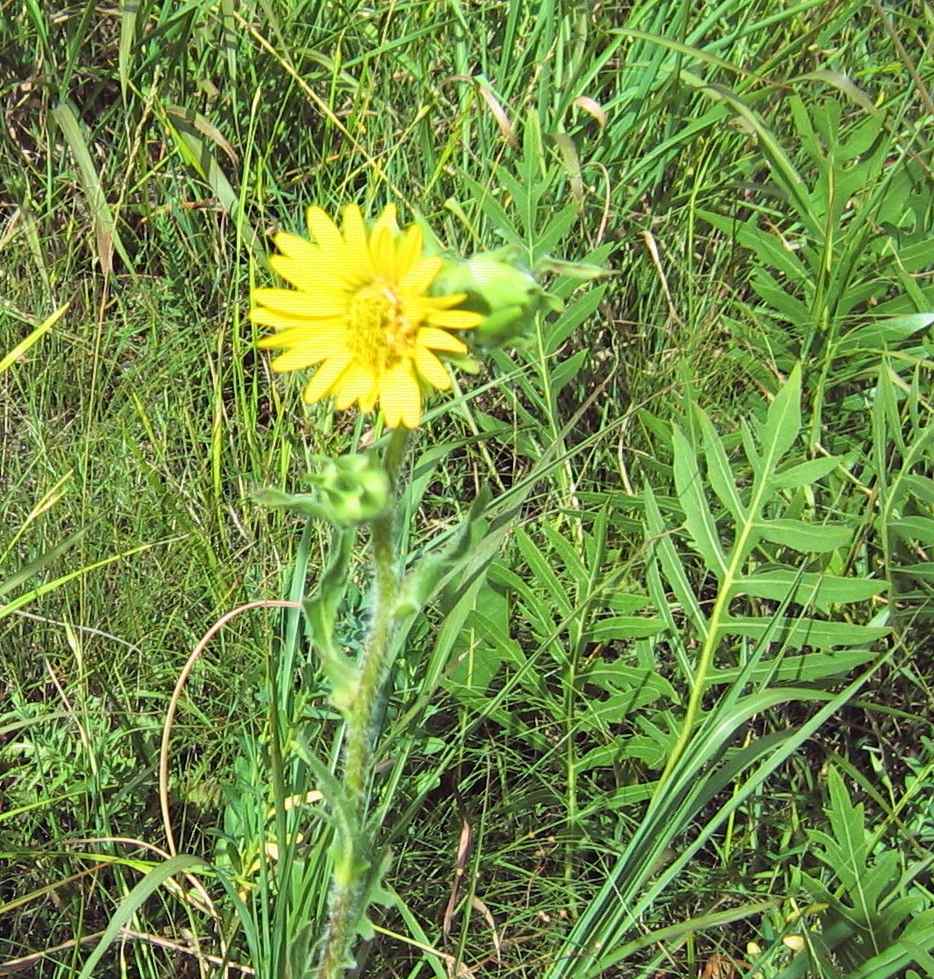
Compass Plant blooms like a sunflower, but its leaves look more like dandelions on steroids. They align roughly north and south. It's a Silphium, related to an ancient species famed in North Africa long ago, a gift from Apollo, god of the sun, prophecy and healing. It represents the sense of place or belonging, of knowing where you need to be.

I still can't remember the names of all the grasses. They sing the wind's song and whisper memories of the ocean bed that once lay here. It was a privilege and a delight to visit this beautiful resource.


Thursday, June 14, 2012

Witchfingers


On long evenings when the light lingers, I remember other summers. The courthouse square was the heart of the town where I grew up: a squat brick building surrounded by a fieldstone wall. Brick streets separated the square from rows of shops, the bank, tavern, drug store, Oddfellows hall, pool parlor and county jail.

There were concerts in the bandstand most Saturday evenings. The grown-ups sat on folding chairs or brought blankets to spread on the lawn. The kids ran around the square on top of the wall, some of them jumping off onto the grass verge from the highest spots. Going all the way around the square on the wall was a challenge. You had to jump over stairways on three sides. An access driveway too wide to jump cut through the east side, so the races usually began and finished there.

At the southwest corner, trumpet creeper vines overwhelmed the wall. I don’t know how old I was when my dad first helped me pluck the bright orange blossoms and put them on my fingers. Getting the fit just right was tricky, especially for little hands. They needed to be snug enough to wave in the air while cackling. One of the hazards of running the courthouse wall was the witchfinger kids lying in wait. If a witch tagged you with an orange claw, you had to start the wall run over.

I usually went home with pollen-stained fingertips. (I don’t recall any ill effects, although I understand that some people have allergic reactions to the plant.) There never seemed to be a lack of flowers, even with kids picking them by the handful. By the next Saturday, the vines were always loaded again.

In my yard, Campsis radicans swarms up an old swing set, waving fronds and fingers above the garden. Also called hummingbird vine, it provides shelter for a feeder. The hummers ignore my sugar water offering once the witchfingers begin to bloom. They buzz bomb the walk beside the vine to assert their territory, swooping down and up in the swift arc of skateboarders.

Friends have asked me why I intentionally planted an invasive vine. Some invasives are more easily controlled in low light. My woods do not allow much competition from cultivated species. The trumpet creeper climbs between a large cedar and a mature hedge tree, surrounded by native hackberry. In so much shade, it has to stretch for the light. The last rays of the midsummer sun illumine flaming bunches of witchfingers. It wouldn’t be summer without them.


Tuesday, May 29, 2012

Honored Weeds


Moonseed vine with Virginia creeper
My favorite definition of a weed: A plant growing in a place that humans find inconvenient. The more plants I learn to identify, the fewer weeds I have to worry about. Pokeweed grows along the roads; its berries can used as a natural dye. Moonseed vine peers out through the Virginia creeper and poison ivy. Its leaves are shaped like delicate maples, its seeds like crescent moons. Almost every place I’ve lived as an adult has been overrun with with garlic mustard. I didn’t know what it was for years. No sooner did I figure out its identity than recipes began coming my way for garlic mustard pesto, quiche, mayonnaise, potato salad, and even pineapple upside-down cake.

Columbine
Sometimes I create my own weeds. Columbine has occupied one of my sidewalks. Wild white violets take over shady spots and migrate into flowerpots. They’re taller than I remember them from my childhood lawn, probably because I can’t bear to mow them down. Lemon balm intends to conquer the known world.


Daylilies
Shade is one of the hazards of gardening under trees. I consider “invasive” a recommendation when I’m choosing new plants. Daylilies were among the first flowers we planted when we moved here. We transplanted spreading ditch lilies, not named hybrids, and foolishly put them directly under walnut trees. It turns out that daylilies are among the plants that flourish despite the toxic effects of the juglone produced by walnuts. We lucked out that time.

Pokeweed
Someone asked me if there were gods of weeds, like Flora who brings flowers and Demeter who helps grain to grow. The Greeks don’t seem to have made much distinction where weeds and deities were concerned. Demeter also wasted the fields, filling them with tares and thistles, while she searched for her kidnapped daughter. Rome was a little more garden-conscious. Robigo and Robigus were deities of mildew and grain rust. The Romans placated them every year at the Robigalia festival. The Goddess Ops, from whose name we have the word opulence, was worshiped as Ops Runcina, destroyer of weeds. My daughter calls her the Goddess Oops, lady of happy mistakes. I'm learning to appreciate her abundant gifts.

White violets
My friend Maggie lives near the river. After a flood destroyed her home, she struggled to rehabilitate her small house. The river took down old trees and planted new willow groves in her woods. It was the next spring before she had time to think about the garden. The mud had been solid as concrete all winter, but weeds began to emerge early. She set a circle of stones around a clump by her door.
Her children worried about her. “Mom, you do know those are weeds, right?”
“These plants split stone to sprout here,” she told them. “They deserve honor.”

Monday, May 14, 2012

County Roads


If you live on an unpaved road, you develop fellow feeling for your neighbors. It’s not the same as a neighborhood, more like a mutual complaint society about maintenance and a secret delight in watching the year unfold along the roadside. We open our car windows to breathe the scent of wild plums in April. Horseback riders and joggers inhale the fragrance of dogwood, sweet rocket and wild roses in May.

Wild plum
Maintenance is fairly good, but of course we all complain when it’s slower than we would like. Most roads seem to be graded once a week. This can result in a line of boulders in the middle of the road for a while — the closest we get to a center stripe. Snow removal depends on conditions all over the county. It doesn’t always get us to work on time. School cancellations are based on the state of the bus routes.

Rough-leaf dogwood
Last fall a crew from the county lopped overhanging trees — a long overdue procedure undertaken because of complaints from the school bus drivers. A week after the mail carrier noticed that the lane was getting muddy, more rock appeared on the road. Residents don’t get that quick a response.

Even the nearest blacktop is a bit primitive. Some of us call it a paved dirt road. The folks in a hamlet just off the blacktop decided to pave their main drag several years ago. It’s only about a mile long, but the asphalt heaves and buckles and cracks all year. Drivers swerve across it randomly, avoiding potholes and washboards. There’s a warning sign just before the crest of the last paved hill. A local wit edited it with press-on letters.


Elderberry and day lilies usually line the ditches in June, but this year they’re starting early. A utility crew cut a swath of small trees and underbrush beside my stretch of the road last year. Mother Elder has reclaimed it all. Her frothy white fronds are budding among poke and ragweed. The witch of the woods is back.


Friday, April 27, 2012

Roses Arrive


Bleu Magenta
Last spring my gardening guru mentioned that he was trying his hand with roses. (I think of him as Quickbeam, Tolkien’s hasty Ent, because he is tall with a booming voice and has been known to sing to trees.) When he tries something, he plunges in as deep as he can go. He ordered 50 or 60 own-root roses, especially those that were reputed to do well in shade. He put them all in containers, because his town does not allow front-yard gardens. The town even puts a limit on pots in front of houses, so the shade-tolerant roses went to live in his back yard. If they did well under his trees, he told me, he might want to transplant some of them to clearings in my woods.

Late in August, after I had forgotten the conversation completely, he called: “When would be a good time for me to come plant roses?” The next weekend, he pulled into my driveway with six full-sized rose bushes and two minis. Bales of organic fertilizer filled the back of his van. His full-time client gave me a resigned look from the passenger's seat and pointed to a rose bush when I brought him lemonade.

Quckbeam started digging holes, and I started carrying water. As the second rose went into the ground, another friend arrived — Rowan, as tall as Quickbeam and 20 years younger. We handed him a shovel. They made short work of roots and rocks that would have taken me weeks to clear. As they dug, Quickbeam recited the pedigree of each rose and instructed me on care and watering.

Bubble Bath
Bubble Bath, a Zone 6 hybrid musk rose, went in nearest the house, where I might remember to give it winter shelter. Three bushes went into the clearing under the power line — Country Dancer, a Buck rose, and two Albas, Celestial and Semi Plena, the white rose of York. Greenmantle, a sweet briar, and Bleu Magenta, a rambler, have the sunniest places beside the road, where they can climb into the trees. I found spots on the patio for the potted minis, Cinderella and Sweet Fairy. When everybody was settled, I dragged the guys inside for iced tea and made Quickbeam repeat the details while I took notes.

September can be hot and dry here. Drought is almost guaranteed if you have six new roses to water. Quickbeam is the consummate gardener, attending to the particular needs of each plant daily. I work more by benevolent neglect and random watering. Still, after such a noble gift, I did my best to keep the roses hydrated. In October the deer began feeding up for mating season. I noticed missing leaves on the roses, then missing canes. Celestial was eventually mowed to the ground. Quickbeam did a little more research and told me that, yes, deer do eat rose bushes in spite of thorns.

Greenmantle
I put tomato cages around the roses. Wire frames can’t really prevent grazing, but deer don’t seem to like bumping their noses while they eat. The roses began to leaf out in March, even Celestial. By April Greenmantle grew as high as my heart.

Yesterday, the first blooms opened on Bubble Bath and Greenmantle. Bleu Magenta is budding, and the three in the shadier spot are fully leafed out. The mini roses came through the winter inside. Sweet Fairy bloomed for us in December.

Quickbeam has started more roses this year, overflowing his yard to the lawn of the group home where he teaches. Once his new rose fosterlings are large enough, he will find adoptive parents for them. He works with the deepest magic, nurturing and sharing the pure joy of being. His spell comes from legend: Johnny Appleseed roaming the wilderness seeding it with beauty. Ecstacy transcends struggle. Exuberance can transform surviving into flourishing.